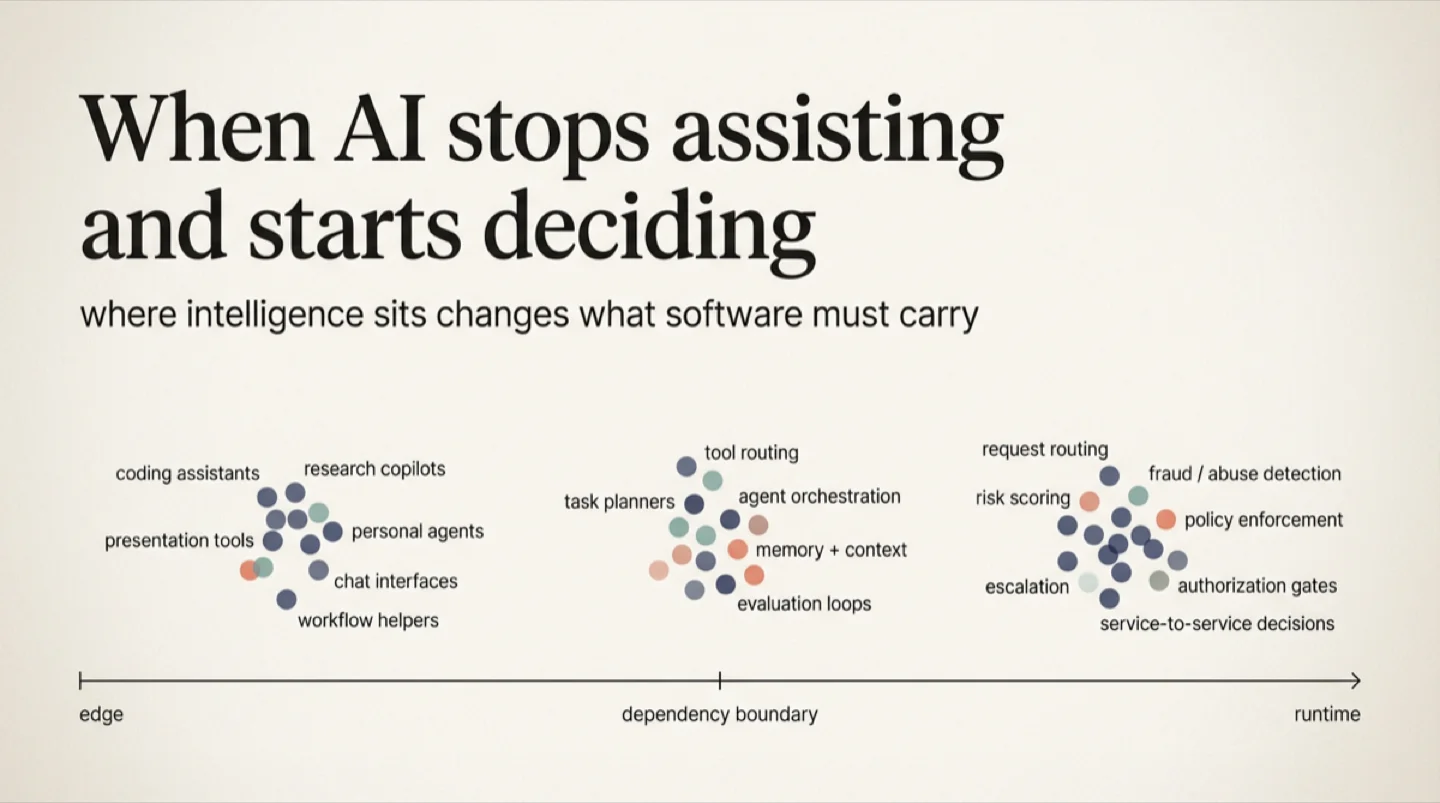
The Split of AI Systems
The speed at which agent-style systems have moved from research to demos to daily use has been remarkable, even as their impact inside real business environments remains uneven.
On the surface, progress looks obvious. Models are more capable. Tools are more accessible. We see impressive demonstrations almost daily, from deep research systems to coding assistants that can scaffold entire projects. And yet, when these systems are introduced into real software environments, especially ones that already operate at scale, the outcomes often feel narrower than expected.
This gap is often discussed in terms of maturity, safety, or trust. Those matter, but they are not the whole story. What seems more revealing is that we are grouping very different kinds of systems under a single mental model. We talk about "AI agents" or "AI applications" as if they belong to the same category, even when they behave very differently once they leave a demo and begin interacting with real systems.
AI Systems Designed for Interaction at the Edge
A large class of current AI systems is built around interaction. These systems live close to the user. They take in loosely structured input, often through natural language, and respond in ways that remain flexible and conversational. Coding assistants, research tools, presentation generators, and personal agents fall into this category.
What makes these systems powerful is not just their reasoning ability, but the role the human plays around them. The person using the system interprets the output, decides what matters, corrects mistakes, and chooses what action to take next. Ambiguity is present throughout the process, but it is resolved socially rather than technically. The system can remain forgiving because a person is holding it together.
These systems are often described as agents because they feel active and responsive. They can call tools, maintain context, and adapt to changing instructions. For an individual user, this feels like delegation. For the surrounding software environment, however, the AI is still operating at the boundary. Its outputs are suggestions, not dependencies.
AI Systems Embedded Inside Software Runtimes
There is another class of AI systems that receives far less attention, partly because it is harder to see and partly because it does not present itself through conversation.
In these systems, intelligence does not sit at the edge waiting for a human to interpret it. It is embedded inside the software itself. The AI operates within a bounded role, often at a specific decision point. It routes a request, evaluates risk, reconciles conflicting signals, classifies an event, or decides whether to escalate. These are decision points woven into the flow of software, invisible unless you know where to look. Nobody interacts with them. Other systems depend on them.
This kind of system is not designed to feel helpful or expressive. It is designed to be dependable. Other services rely on its output. Downstream processes assume it behaved correctly. There is no person standing by to smooth over ambiguity or reinterpret intent after the fact.
What makes this pattern subtle is that the intelligence involved can be just as sophisticated as anything we see in interactive systems. The difference is not reasoning power. The difference is responsibility. Once an AI system begins to act as part of a runtime, it stops being an assistant and starts behaving like software that other software depends on.
Where the Real Distinction Appears
Once these two patterns are placed side by side, a deeper distinction becomes visible.
Ambiguity always exists in systems that interact with the real world. Inputs are incomplete. Signals conflict. Context changes faster than code can be updated. The question is never whether ambiguity is present. The question is where it is allowed to live.
In interaction-first systems, ambiguity is pushed outward. The AI produces a response that may be partial, approximate, or situational. A human reads it, interprets it, and decides what to do next. The system remains flexible because the resolution happens outside the software boundary.
In runtime-embedded systems, ambiguity moves inward. The AI still reasons over messy signals, but it does so inside a bounded role. What enters the system is structured. What leaves the system is structured. Other software depends on that output behaving consistently enough to be acted upon.
This difference matters because the moment an AI output becomes a dependency, ambiguity changes character. What was previously tolerable becomes fragile. A suggestion can be vague. A decision cannot.
Why the Requirements Change When Intelligence Moves Inward
When intelligence sits at the edge, the primary question tends to be whether the system is helpful. When intelligence becomes part of the runtime, the question shifts almost immediately: is the system safe to depend on?
This shift does not happen because of organizational caution or regulatory pressure. It happens because software has expectations of other software. A system that consumes an AI decision implicitly assumes that someone or something was authorized to make it. It assumes the decision can be traced, revisited, and explained if needed. It assumes failures are contained rather than amplified.
Questions begin to surface naturally. Who authorized this action. What context did the system rely on. Can this decision be replayed or audited later. What happens when the system is wrong.
A Simple Way to Tell Which Pattern You Are Dealing With
There is a simple question that clarifies this distinction more reliably than most architectural diagrams.
If an AI system produces a wrong outcome, who notices first?
If the answer is a person reading a response, the system is operating at the interface. The human acts as the checksum. If the answer is the system itself, the AI is part of the runtime. Infrastructure has to play the role of checksum. It must detect anomalies, enforce boundaries, and surface issues without relying on a person to notice something feels off.
Both patterns matter. Interaction-first systems unlock speed and creativity. Runtime-embedded systems enable delegation at scale. One does not replace the other. What changes is responsibility.

Santosh Kumar Radha
Physicist & CTO at agentfield.ai — building AI infrastructure for the future.